NAVIGATING ANGST. The theme of VIENNA ART WEEK 2026
Angst is more than a feeling — it’s the very structure of our present. A constant hum beneath political upheavals, ecological crises, and digital overload. But what if we saw it not as paralysis, but as a catalyst — a force that compels us to rethink, adapt, and act?
By Anne Zühlke and Robert Punkenhofer
How does art help us navigate the rocky terrain of the present? How do we navigate art through the shoals of political turmoil? And what does it mean to orient ourselves with the help of art, without any claim to fixed coordinates?
VIENNA ART WEEK 2026 takes as its point of departure an experience that is ubiquitous yet rarely articulated with precision: Angst—understood not simply as fear or anxiety, but as a more fundamental condition, less a symptom of crisis-ridden times than their very structure.
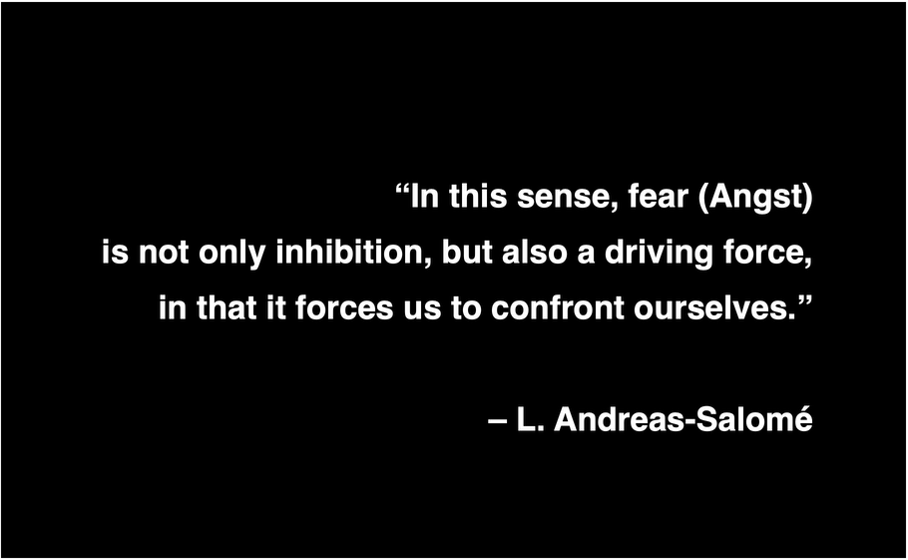
“In this sense, fear (Angst) is not only inhibition, but also a driving force, in that it forces us to confront ourselves.” (L. Andreas-Salomé)
Current political, economic and cultural shifts permeate everyday life, the body and perception. Psychoanalysts such as Lou Andreas-Salomé and Sigmund Freud described this tipping of the familiar into the uncanny and, with it, an experience that today is less the exception than a prevailing condition. The writing of Franz Kafka similarly revolves around this form of structural uncertainty: his characters move through systems whose rules are at once precise and incomprehensible. Orientation is demanded but never secured.
For generations, artists have taken this very uncertainty as a point of departure for artistic production. In the photographic work of Nan Goldin, vulnerability emerges as a collective reality in which intimacy and social violence are inseparably intertwined. Ed Atkins extends this line of inquiry into the digital realm: his hyperreal avatars grapple with alienation, loss of control, and emotional overload in a technologically mediated present. Here, Angst is not resolved but made legible as something that articulates itself through bodies and images.
This legibility is inseparable from the continuous production of images. We don’t just live with them; we live through them. In Simulacres et Simulation (Simulacra and Simulation), the French philosopher Jean Baudrillard describes how images detach from representation and become autonomous producers of reality. Today, in the stream of real-time images from war zones and the circulation of AI-generated content, this dynamic has taken on renewed urgency. Images do not simply inform, they affect, direct, destabilize. Artistic practices such as those of Hito Steyerl or the collective Forensic Architecture engage precisely at this point: they analyze image production as a political practice, expose its conditions, and reveal the extent to which perception itself has become contested terrain. Others, such as Tony Oursler, blur the boundary between inner and outer reality by staging images of Angst as projections of psychic states that merge with media surfaces.
These aesthetic strategies do not stand apart from political dynamics but are deeply embedded within them. Current shifts in global power relations are accompanied by a rhetoric of fear that deliberately simplifies through the construction of enemies, the drawing of boundaries, and the attribution of blame. Bodies become sites of projection, especially those that resist normative orders. In his speculative essay Ten Queer Theses on Abstraction (2019), the art historian David Getsy describes the resistant potential of abstraction where social forces seek to render bodies legible and fixed. Art does not counter this fixation with simple oppositions, but through practices that unsettle clarity and render identity as something in motion.
“Abstraction makes room for a different kind of sedition
against the imposition of normativity.” (D. Getsy)
The fact that this uncertainty is fueled in no small part by ecological conditions only heightens its urgency. The climate crisis, resource scarcity, and global conflicts over distribution produce a sense of ongoing provisionality. Artistic practices respond with approaches that resist easy solutions. They move between utopia and dystopia, testing models of coexistence in which human life is not necessarily at odds with the preservation of the planet. Within an expanded understanding of relationality that includes nonhuman actors, Angst becomes a sensorium for a disrupted equilibrium.
Constant uncertainty never disappears, but can be turned to productive ends, as the Caribbean philosopher and poet Édouard Glissant suggests in his Poetics of Relation. Identity is not fixed but emerges through contact, difference and movement. To engage with this means relinquishing the impulse to reduce complexity in favor of clarity and instead gaining the capacity to navigate within it. In this sense, Angst marks not a standstill but a threshold: the moment when familiar orders become porous and other ways of thinking and living together come into view.
At the same time, artistic production and the conditions of life as an artist are deeply shaped by structural factors. Art is produced under economic pressure, within institutional frameworks, and often under precarious conditions. For many artists from marginalized contexts, these conditions intensify into existential challenges. And yet it is precisely here that practices emerge that make uncertainty productive: through collaboration, open-ended processes, and the deliberate use of indeterminacy. Navigation becomes a method.
Against this backdrop, Navigating Angst is conceived not as a thematic framework, but as an invitation to enter this complex constellation. VIENNA ART WEEK does not aim for resolution but for intensification. It takes the present seriously in all its contradictions and invites engagement without succumbing to overwhelm. Perhaps this is where a form of orientation can be found: not in reassurance, but in the capacity to endure complexity and remain able to act within it.