host_age:// is a long-term curatorial research project exploring the growing preference for security and control over freedom, rights, privacy and democracy.
The title is a play on words, suggesting that the host/hostage relationship defines our age. The etymological link between guest, ghost, host and hostage reveal their conceptual interconnectedness and the dynamics of hospitality and hostility. Hospitality cannot come into presence without a degree of hostility, as the guest is subject to the host’s decisions. Over time, the guest may slowly turns into a hostage within the territory where they were once welcomed. Examples include migrants who become stuck in a host country due to complex visa issues or privileged residents, who voluntarily confine themselves behind the walls of gated communities in an attempt to protect themselves from the chaos of poorer neighbourhoods. Pandemic conditions have also held millions hostage in their own homes.
The figure of the hostage reflects the logic of a post-control society, in which individuals are no longer disciplined only by physical borders but their seemingly “free choices”. A host is also a computer accessible over a network – the title is thus written in a way that evokes code language, referencing the extension of the host-hostage dynamic into the digital realm. It suggests that we are living in the “host age” or “hostage age”, where we feel trapped within systems. Corporations tracking personal data, social media addiction, algorithms that polarize political discourse, and AI technologies replacing human labor all illustrate how we are voluntarily held hostage by certain ideological, economic, and technological structures.
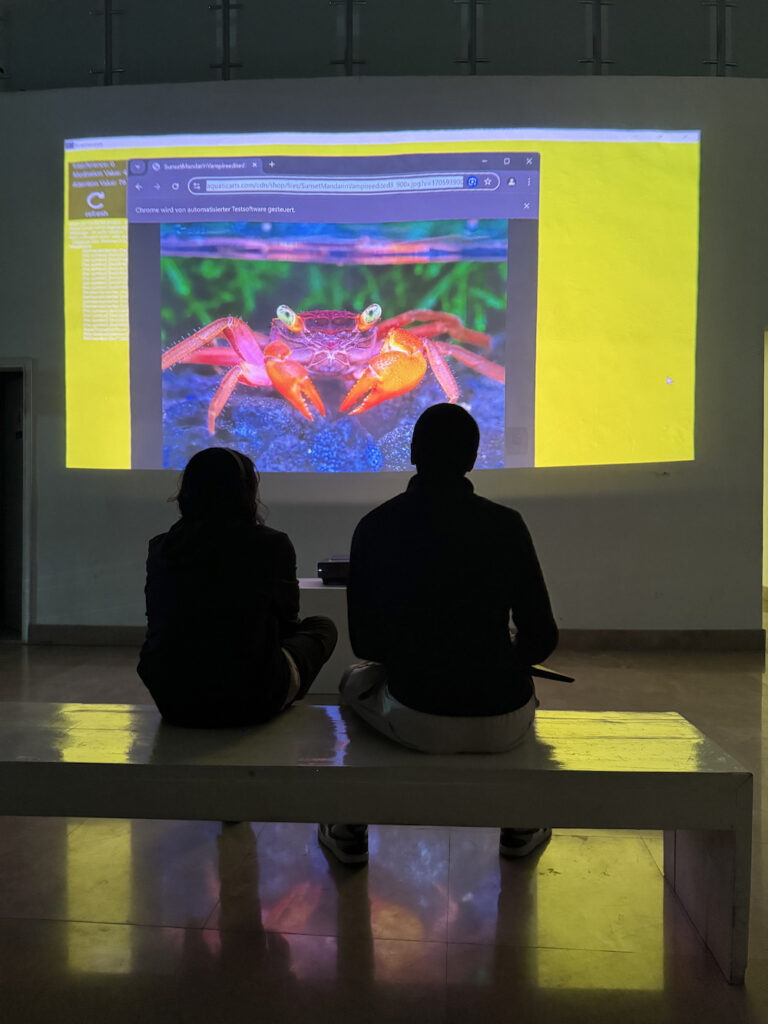
The exhibition is the first in a series that explores the relationship between surveillance capitalism, border technologies, and freedom. In his research, Žarko Aleksić investigates the interaction between human consciousness and AI. Using facial recognition and targeted ads based on personal information, he examines how AI uses private data to construct versions of our identities. His artwork, What Google Wants, developed during pandemic questions whether AI attempts to “know” us better can be interpreted as a form of psychoanalysis, often one driven by surveillance and exploitative purposes. Similarly, Brian Web, a project by Laurus Edelbacher and Azalea Ortega Flores, focuses on the dynamic relationship between human consciousness and the digital realm. Using a specially designed EEG headset, users’ brain activity is measured, and a custom-built system interprets these signals to curate web content based on the user’s cognitive-emotional state. In the interactive game installation, Borderline, Edelbacher reconstructs real-time border zones from various locations as interactive 3D environments in a game engine, using footage from surveillance cameras.
Curated by Deniz Güvensoy
Opening: 'host//:age'
11 Nov 2025/19:30-21:00H
Fabrikraum
Johnstraße 25-27/r02 2, 1150 Wien, Österreich
Brainweb, Interactive new media art installation, Laurus Edelbacher, Azalea Ortega Flores