Spatial Qualities – Helga Philipp at the Albertina
The exhibition is dedicated to the multifaceted body of work by the Viennese artist, whose pieces transform space into a category that can be experienced visually. A text by Sabine B. Vogel
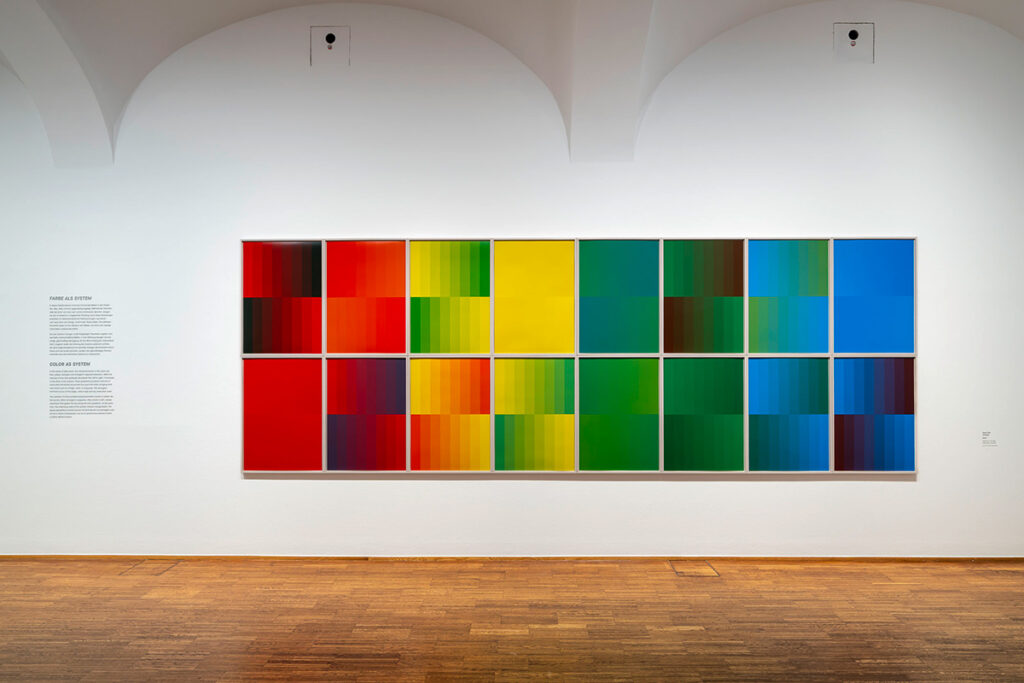
Helga Philipp Untitled, 2002 Silkscreen print, 16-part series Estate of Helga Philipp © Estate of Helga Philipp Exhibition view: ALBERTINA, Vienna / Ana Paula Franco
If you want to understand what the elusive concept of “space” means as a theme in art, you should visit the Albertina right now. Four decades of Helga Philipp’s work are on display in the Pfeilerhalle.
Born in Vienna in 1939, she began her art studies at the age of 14 at the University of Applied Arts—and remained a pioneer throughout her life. Classically trained in sculpture under Hans Knesl, she experimented throughout her life with structures, serial arrangements, and materials such as glass, metal mirrors, and aluminum to transcend the boundaries of surfaces.
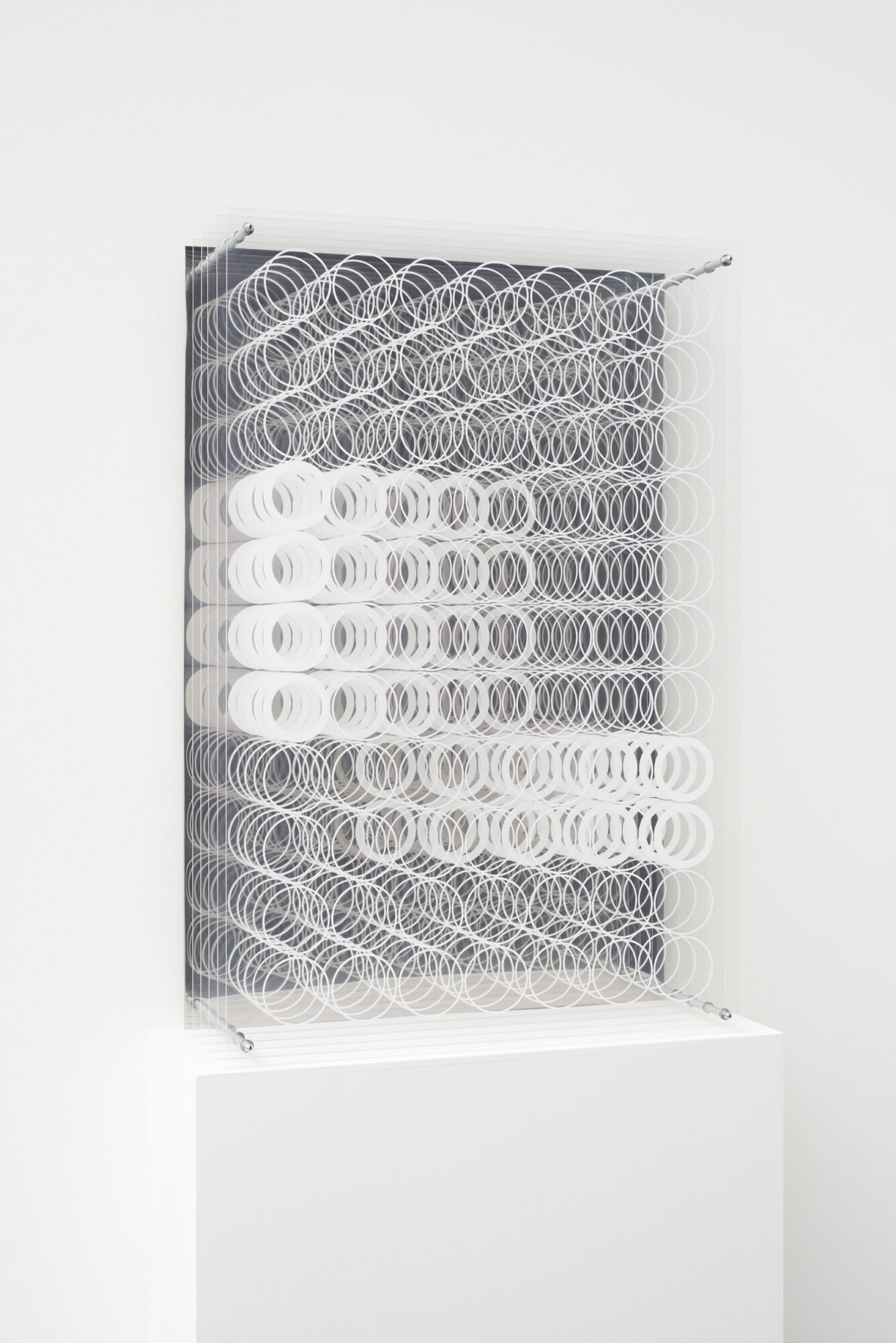
Helga Philipp, Untitled (Kinetic Object), 1971. 120 × 79 × 32 cm, lacquer, Plexiglas, metal mirror. Lentos Art Museum Linz, donated by the Friends of the Lentos Art Museum © Estate of Helga Philipp. Photo: Lentos Art Museum Linz / Reinhard Haider
She uses color not as a medium of expression, but as a system. Whether wall-mounted works or objects, her pieces follow a clear order, are based on strict, formal elements, and, above all, engage the viewer. This is already true of Philipp’s early checkerboard-like objects from the 1960s, which we perceive differently with every step, even as visually shimmering. But it also applies to the modular arrangements of circles or the astonishing disorder she introduces into what are essentially regular patterns.
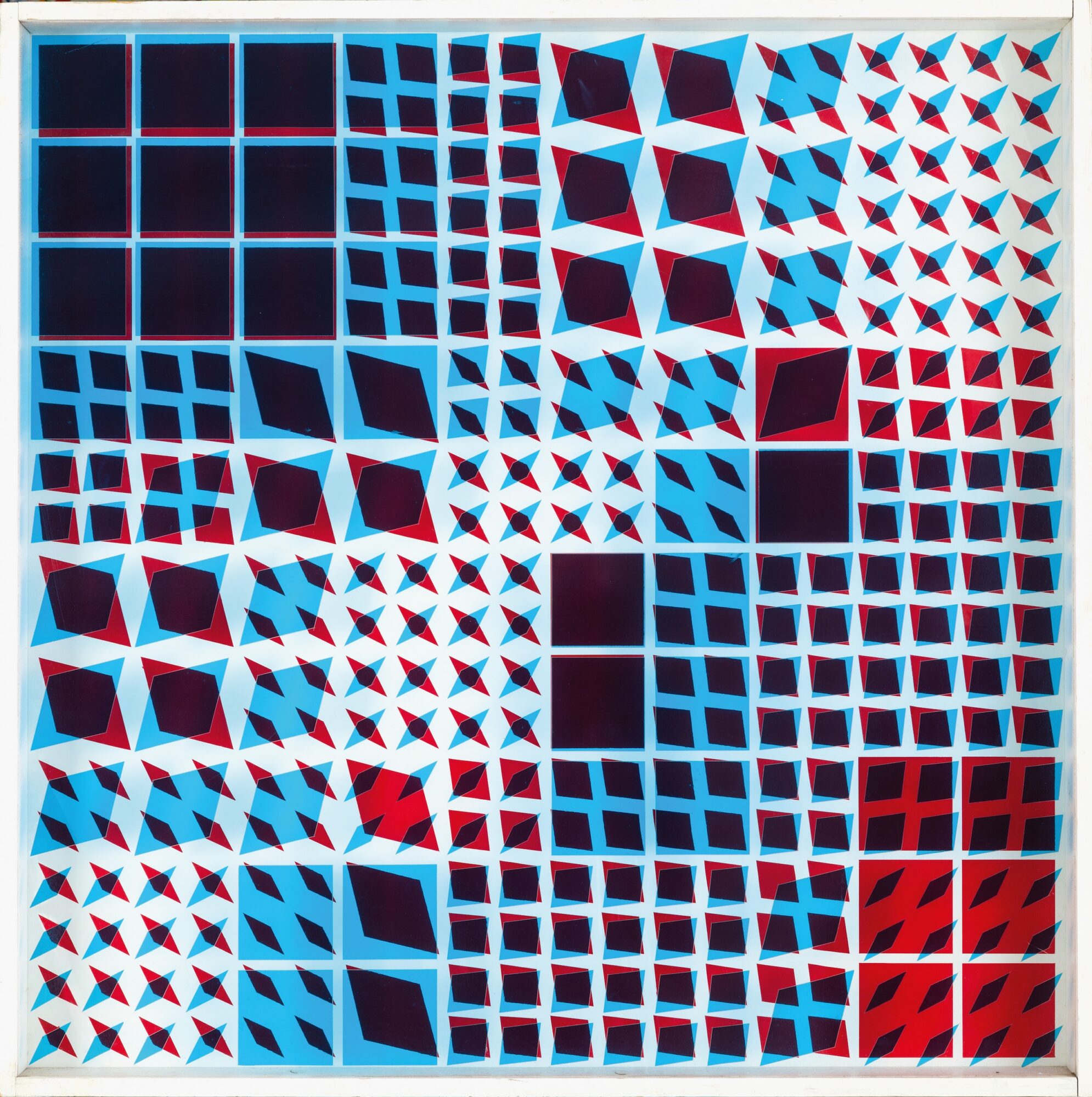
Helga Philipp, Untitled (Kinetic Object), 1966–1968. 115 × 115 cm, lacquer, glass, wood. Private collection © Estate of Helga Philipp. Photo: Estate of Helga Philipp
In art history, parallels are drawn here to Concrete Art, Op Art, and Kinetic Art. But Philipp’s work is far more than that; it is a constant exploration of space: How can space be created in two dimensions? How do viewers perceive space? Through superimpositions, some of her works seem to move, even to expand—though this happens only in the eye of the beholder.
In 1962, Umberto Eco published his groundbreaking essay “The Open Work”: A work of art is not unambiguously defined; it is only the viewer who activates and completes it in the moment of viewing. Philipp’s work is like proof of this theory, extending far beyond the aforementioned art-historical categories—for instance, when the glass panels with diamond patterns, suspended freely in space and layered one behind the other, continue as shadow patterns on the floor of the Pillar Hall. Or her rarely exhibited, 56-part series “Domino.” Instead of numbers, the two square image fields in each piece display shades of gray. It is an open system without a fixed center, which always reassembles itself differently in the act of viewing—magnificent!
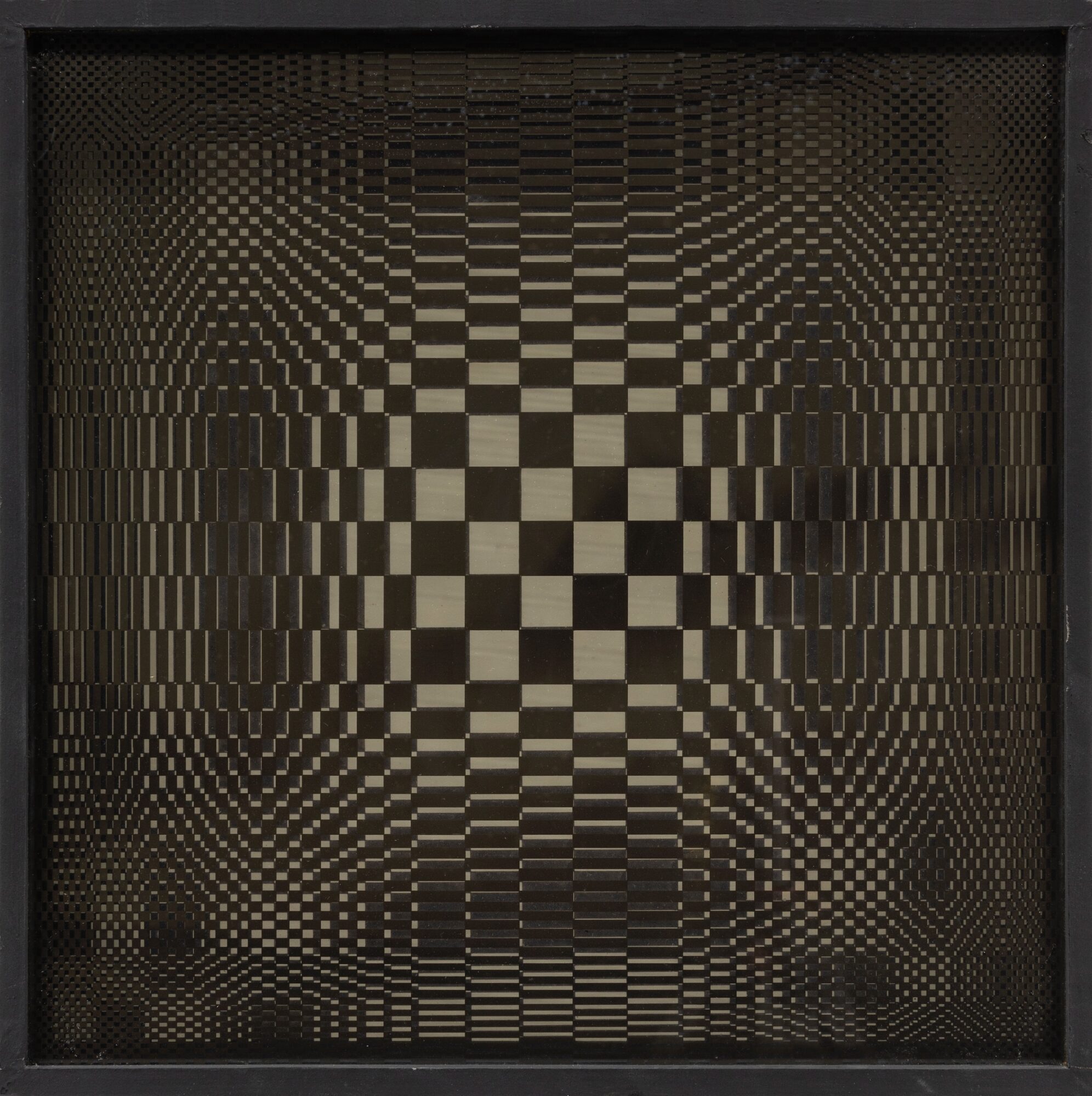
Helga Philipp, Untitled (Kinetic Object), 1962–1963. 40 × 40 × 6 cm, silkscreen print, glass, wood. Private collection, Verona © Estate of Helga Philipp. Photo: Mattia Mognetti, Courtesy of 10 A.M. ART Gallery, Milan
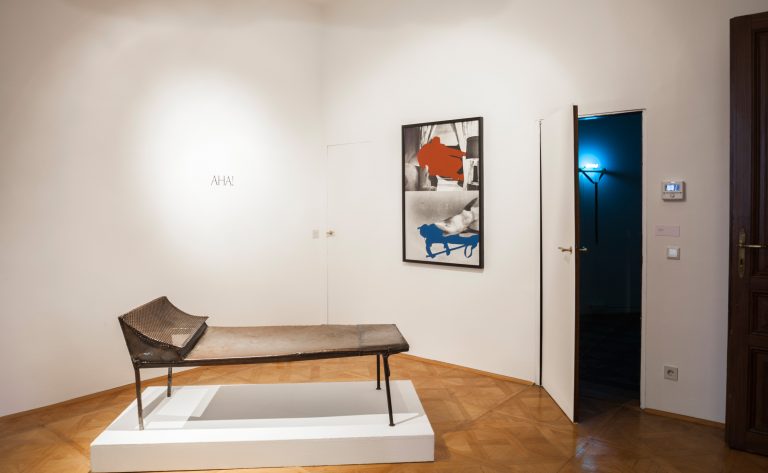
In the Pfeilerhalle, curator Elsy Lahner has paired Philipps’ seating furniture with the works, translating the variations on the circle into the space—it is striking how the significance of the in-between space becomes visible here: within the works, between the works, and between the works and the viewer.
Space, as Philipps’ work shows us, is a category that can be experienced visually. Or as the artist, who died far too young in 2002, put it in her “Manifesto” of 1967/68: “image – viewer / viewer – image / incorporation of space into the image / movement in space within the image,” and at the end of the 22-line text: “change of the image through change of the viewer / quality of the viewer / quality of the image.”
HELGA PHILIPP
Spaces of Movement
Until September 20, 2026
Albertina