EVENT LANGUAGE: ENGLISH
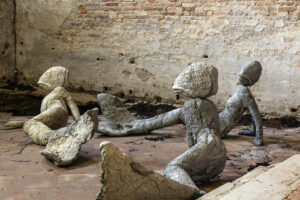
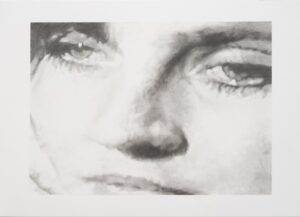
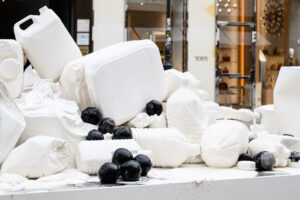
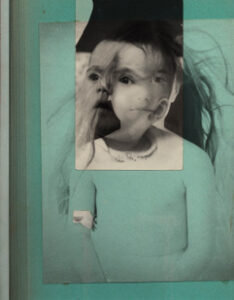
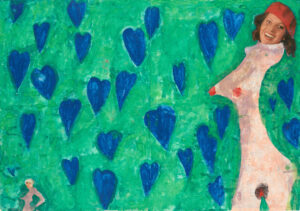
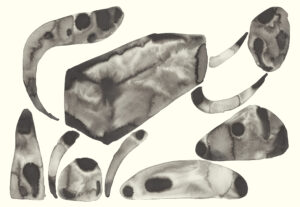
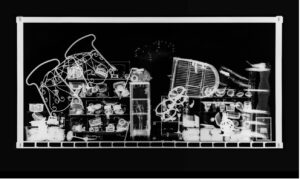
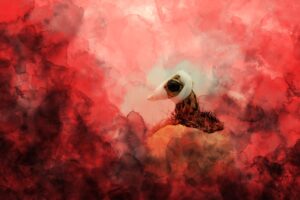
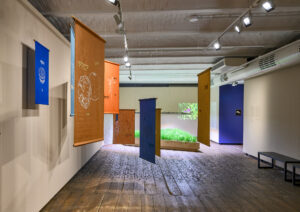
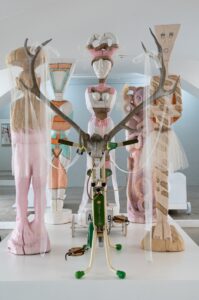
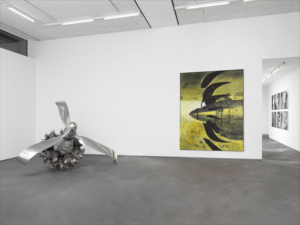
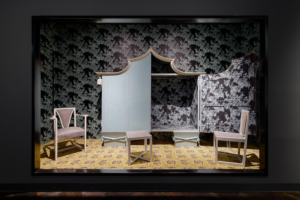
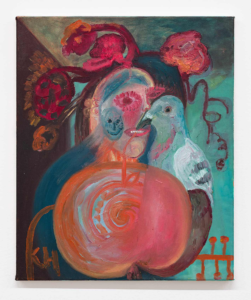
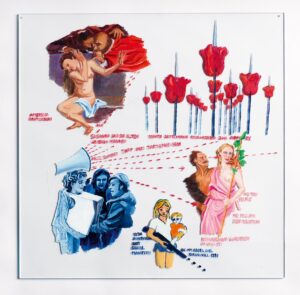
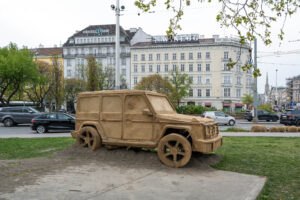
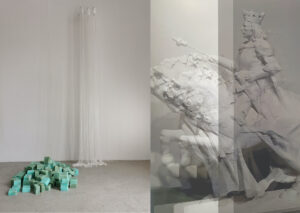
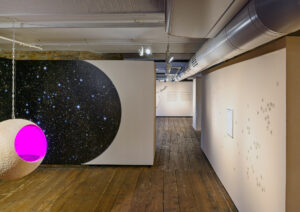
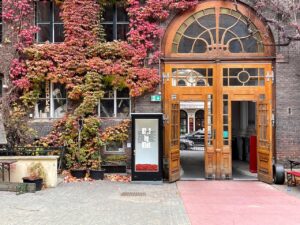
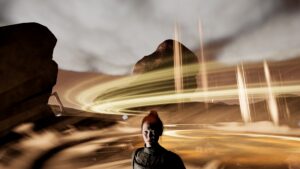
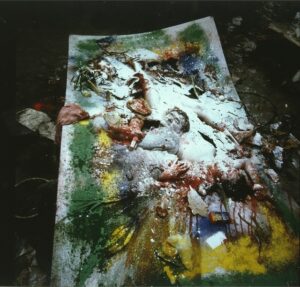
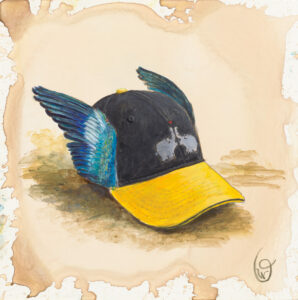
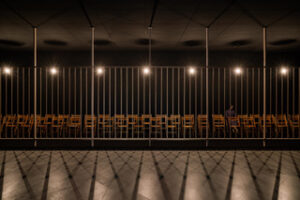
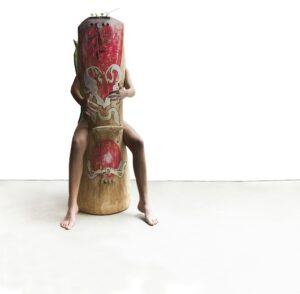
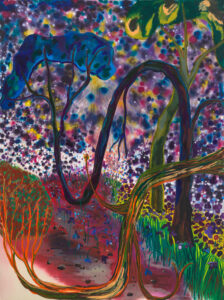
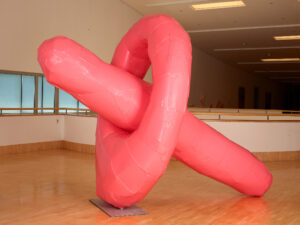
‘PARATETHYS/PAKIKIRAMDAM (Sensing the Sea)’ by Jon Cuyson is a site-responsive installation developed for Vienna Art Week 2026 in the context of a basement space in a Viennese apartment building at Operngasse 4 in the center of Vienna, curated by Klaus Speidel and co-curated by Ken Mapayo. Through painting, sculpture, sound and moving image, the project responds to the architecture of the cellar as a place of pressure, storage, sediment, rest and, potentially, fear, that is always also present in cellars as hidden spaces.
The installation takes as one of its starting points the fact that present-day Vienna was once covered by an ancient sea, PARATETHYS. This prehistoric sea is not approached as a distant past, but as a condition that is compressed into layers and in the form of trace. The cellar becomes a collection of geological, architectural and emotional histories. Memory is not retrieved in form of the fiction of a clear narrative, but sensed as something held within matter, atmosphere and time in a floating state.
PAKIKIRAMDAM, which in the Philippino language Tagalog means Sensing or shared inner perception, brings in the dimension of care that is especially relevant when someone, including ourselves, experiences a state of Angst (https://www.psychotherapy.net/perspectives/articles/using-the-filipino-practice-of-shared-inner-perception-in-psychotherapy/).
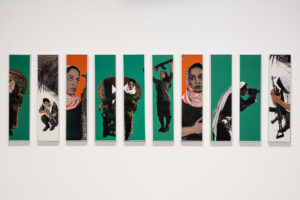
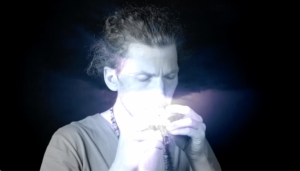
Responding to the theme ‘Navigating Angst’, Cuyson approaches Angst as a state of tension rather than a problem to be resolved. The work offers a set of coordinates, but no linear story. Instead, it creates a relational environment in which forms remain partial, suspended and dependent on one another. Paintings, objects, sounds and moving images are arranged so that no element stands alone; each is held, interrupted, filtered or activated by another.
The project thus unfolds around three key ideas:
Ancient Sea, Sedimented Stories, and, finally, Care and Rest as strategies to counter Angst. The ancient sea provides the geological and imaginative ground of the installation. Sedimented stories point to histories that are not fully visible, but continue to shape the present from below. Care and rest emerge from the specific character of the site itself: a basement that is not only a space of depth and pressure, but also a place of withdrawal from the surface of the city.
However, while being emerged in water can be calming, the idea of rising water levels is also one aspect of climate anxiety, a contemporary form of angst that appears more and more in therapeutic settings and has been linked to at least one suicide in Belgium, where a man suffering from climate anxiety took his own life in 2023 after a prolonged interaction with an AI chatbot around climate anxiety. In this context, the deeply human ability for PAKIKIRAMDAM as a way to engage and empathize without judgment is a far cry from chatbot “sycophancy” that simulates care for engagement.
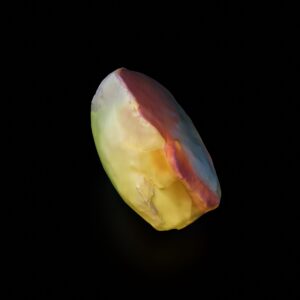
A central speculative method is what Cuyson calls “Mussel Thinking”, an approach foregrounded in Cuyson’s pavilion of the Philippines at the current Venice Biennial. Mussels have survived for about 80 million years and thus connect us back to our prehistoric past. They filter, attach, cluster and sediment. They survive through relation, taking in what surrounds them and transforming it over time. In the installation, Mussel Thinking becomes both a way to understand how bodies, forms and histories persist, and a way of connecting. It offers a model of interdependence: nothing exists alone, and nothing remains untouched by what passes through it. Care is here understood as a fragile approach to Angst made possible through relation, attention and shared vulnerability.
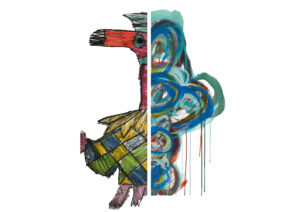
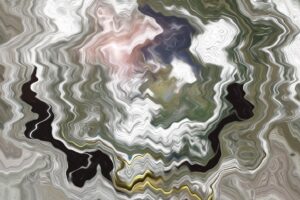
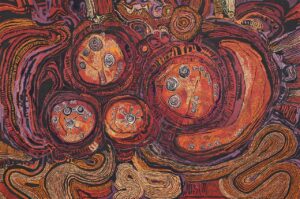
Cuyson’s use of abstraction is crucial to this approach. Rather than making histories, identities or affects immediately legible, the work allows them to remain layered, partial and opaque. This resonates with David Getsy’s understanding of queer abstraction as a form that resists the demand for fixed visibility and normative classification. Getsy argues that abstraction can create “a different kind of sedition against the imposition of normativity,” precisely because it refuses to make bodies and relations instantly recognizable or easily categorized.
This dimension, too, connects the Vienna installation to the Venice pavilion which, among other things, tells a story of a queer seafarer. Yet, in PARATETHYS/PAKIKIRAMDAM, queerness is not treated as part of an explicit iconography or as a message to be decoded. It appears as a way of holding relation open: through fragmentation and refusal of closure. Abstraction becomes a means of protecting complexity rather than simplifying it. It allows the work to address pressure, care, memory and desire without reducing them to a single image or narrative.
The cellar activates this logic spatially. It is both shelter and burden, retreat and compression, rest and unease. It evokes the pressure of geological time, but also the more immediate pressures of bodies and histories that are held below the visible surface and reminder of the possibility of the return of the water in times of climate change.
PARATETHYS/PAKIKIRAMDAM (Sensing the Sea) then proposes the basement as a sedimented environment for navigating Angst. The ground beneath Vienna is imagined not as stable foundation, but as a layered field of ancient water, pressure, memory and relation. Here, Angst is not overcome. It is inhabited, filtered and held, until other forms of attention, care and rest become possible, mediated through PAKIKIRAMDAM and Mussels Thinking.
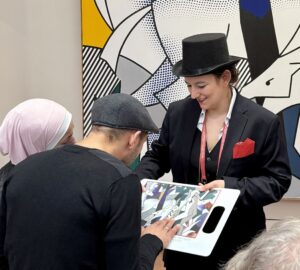
As part of the events, we plan to hold screenings, guided tours and talks, among others with Prof. Dr Mathias Harzhauser, Director of the Geological-Palaeontological Department of the Natural History Museum Vienna (tbc), who is a leading researcher on the Paratethys, who explains that « the Paratethys, a marginal sea of Eurasia in the Earth’s history, was more than twice as rich in species as today’s Mediterranean, and even harboured more species than today’s Red Sea. Today, this Miocene biodiversity hotspot is only surpassed by the tropical diversity around the Philippines. », making the Philippines present an image of Vienna’s ancestral past.
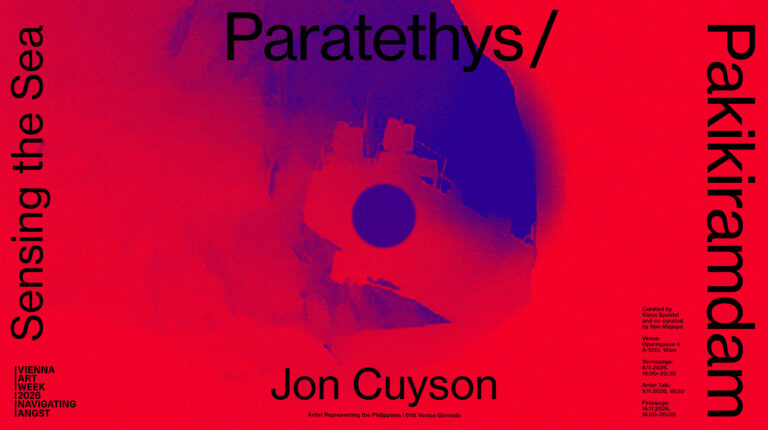
Opening: 'PARATETHYS/PAKIKIRAMDAM (Sensing the Sea)'
8 Nov 2026/18:00-20:30H
Operngasse 4
Operngasse 4, 1010 Wien, Österreich
Paratethys:Pakikiramdam
OTHER EVENTS